Objective 4
- At the end of this topic, you will be able to list at least five important topics that Paul discusses in both Galatians and Romans.
Objective 4
- At the end of this topic, you will be able to list at least five important topics that Paul discusses in both Galatians and Romans.
|
Lesson 1: Introduction and Preview to Romans
Topic 1: Background Information (Continued)
|
Romans was the last epistle Paul wrote before his imprisonment. Its theme and content are more similar to those of Galatians than to those of any other epistle. Galatians was written after Paul's first missionary journey; Romans was written after the third. During the intervening eight years of ministry, Paul had developed more thoroughly the truths that he had written so urgently to the Galatians. Now, at almost sixty years of age, Paul writes a systematic theological presentation of the teaching that he had given the Galatians.
The heart of Paul's gospel is the theme of justification by faith. We find in Romans an expanded teaching of this great doctrine of the Scriptures. In Galatians, the emphasis was on the fact that we are saved not by works of the law but by faith in Christ. In Romans, we see the doctrine of justification by faith from a different viewpoint and with a different emphasis--the righteousness of God. The same theme is discussed, but the emphasis is on faith as the way in which the righteousness of God is revealed.
Two Emphases:

Besides the main theme, you will find many subtopics or points of doctrine in Romans that you have already studied in Galatians. Faith is contrasted with works in Romans 3-4. Flesh (self-effort) is contrasted with the Spirit in Romans 7-8. Abraham is presented as a man of faith, and God's promise to Abraham is linked with the gospel. Paul discusses again the theme of divine love. The doctrine of the crucified Messiah and the significance of His work was mentioned briefly in Galatians and is presented more clearly in Romans. Both speak of circumcision and the Christian's relationship to the law.
In Romans, Paul discusses some additional doctrines, too. Besides the question "How can a man be just with God?" he deals with such questions as: "What is the significance of Israel in history?" "What should the attitude of Gentile Christians be toward the Jews?" and "What are the practical evidences of Christian character?" Paul's answers to these questions provide us with a wealth of spiritual truth.
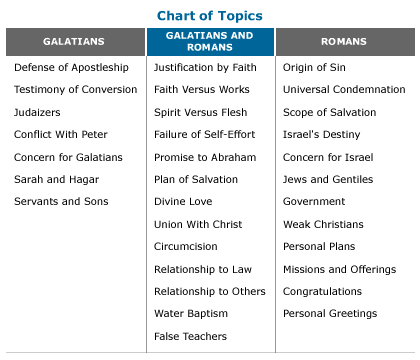
Paul uses two sets of contrasts in both Romans and Galatians. They are: "by faith--not by works" and "by the Holy Spirit--not by flesh." He teaches that the Christian is justified by faith, not by anything he does (Rom 1:17). He goes on to teach that the Christian's life is to be controlled not by fleshly desires, but by the Holy Spirit (Rom 8:9).