Objective 3
- At the end of this topic, you will be able to list three ways in which the church at Rome may have begun, and to identify in Romans 16 four observations about the church there.
Objective 3
- At the end of this topic, you will be able to list three ways in which the church at Rome may have begun, and to identify in Romans 16 four observations about the church there.
|
Lesson 1: Introduction and Preview to Romans
Topic 1: Background Information (Continued)
|
We are not sure how the church at Rome began. We do know that some of the Christians living there accepted Christ before Paul was converted (see Rom 16:7). Wherever Christians went, they told people about Jesus. They met together in their homes for prayer, reading the Septuagint (Greek Old Testament), and fellowship. As more people accepted Christ, these home congregations multiplied all over the city.
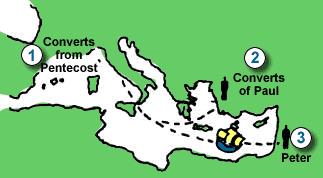
Many people believe that some of the pilgrims present in Jerusalem for the feast of Pentecost in AD 30 heard Peter preach the gospel, were converted and filled with the Holy Spirit, and took the good news back to Rome. You can learn about this by reading Acts 2:1-12.
Because Rome was the capital of the empire there were many opportunities for the gospel message to be brought to the people there. People frequently traveled between Rome and its provinces. In English, we still have the saying, "All roads lead to Rome." As Christian churches were established in such great population centers as Jerusalem, Antioch, Thessalonica, Philippi, Corinth, and Ephesus, many of the converts would visit the capital and tell their friends there about Christ.
You can see in Romans 16:3-16 that Paul had many friends in the church at Rome, although he had never been there. He sent greetings to people that he had met in different places. Some of them had been converted under his ministry but were now living in Rome.
Read Romans 16 and observe as many details as you can about the early Christian church.
Did you notice that the church met in the homes of the believers? The names inform us that the members were probably from many nationalities: Roman, Jewish, Greek, Asian, and Persian. Some of Paul's tribal kinsmen, who had been converted before he was, were there. The first convert from Achaia (or rather, the province of Greece) was there. Several women are mentioned as having an important part in God's work. Do you wish Paul had told us more about Phoebe when he recommended her so highly to the church? Some think she was a Christian businesswoman who took Paul's letter to Rome on one of her business trips. Some suggest she may have been a legal representative who defended the persecuted Christians in court.
Now read Romans 16:1-16 again in the light of these observations. A third possibility about the origin of the Christian church in Rome is the tradition that Peter went there and preached the gospel. Many people believe that he took the good news to the Jews living in Rome and founded the church.
The original group of believers in Rome most likely consisted of Jewish Christians. There was a Jewish community in Rome as early as the second century BC. The Roman government expelled the Jews from the city at least twice but later allowed them to return. Aquila and Priscilla (Paul's fellow workers in Corinth) were forced to leave Rome when the emperor Claudius ordered the Jews to leave (see Acts 18:2). It is possible that they were already Christians before they met Paul. Later, they returned to Rome and were among the church leaders to whom Paul sent his special greetings in this epistle (see Rom 16:3-5). Paul mentions also some of his Jewish kinsmen in Romans 16:7, 11.
In Romans 9; 10; 11, Paul's discussion about Israel leads us to believe that there were some Jews in the Roman church. However, by the time Paul wrote this epistle in AD 57, Gentile Christians seemed to outnumber the Jews in the church at Rome. Perhaps this was one reason why Paul felt the responsibility of sending them this thorough exposition of the gospel.
When Paul finally reached Rome three years after writing this epistle, the circumstances were very different from those he had planned. While in Jerusalem, he had been accused of speaking against the temple and was put in prison. Paul finally appealed to have his case transferred to the jurisdiction of the emperor in Rome. On the way there as a prisoner, he was shipwrecked and spent a winter on the island of Malta. He reached Rome in AD 60.
The history of Paul's ministry in Acts ends abruptly after telling us that he spent two years in Rome under house arrest. In Acts 28:30-31, we see that during these two years Paul was preaching and teaching about Jesus Christ with all confidence.
What happened at the end of these two years is uncertain. From his letters, it seems that he was released after his trial and was able to travel again in the ministry for a short time. Soon afterwards, when a new persecution arose, it seems certain that he was arrested again and sentenced to death at Rome as a leader of the Christians. Paul was led out of the city and beheaded, but the persecution did not destroy Christianity in Rome. The church continued to grow and flourish in that great city.